Ham radio and homemade projects
Hi, I'm Naresh, a radio amateur and maker. On this site you can find out what ham radio is, try Morse code in your browser, and see the things I build.
Your first steps
- Listen firstHear real hams before you buy anything. A cheap SDR dongle and a laptop are enough, or visit a club and listen on their radios.
- Find a clubA local club helps you learn and lets you try real radios. In Sweden: SSA member clubs. In India: ARSI, see "Affiliated Clubs".
- Take the examThen you get your own call sign and can go on the air. How to get a licence
What is ham radio?
A licensed hobby that lets you talk to the world with a radio you understand.
Amateur radio, or ham radio, is non-commercial use of the radio spectrum for talking to other operators, experimenting with electronics and helping out in emergencies. Hams build antennas, bounce signals off the ionosphere to reach other continents, contact satellites and keep messages moving when phones and the internet go down.
In India it is regulated by the WPC Wing of the Department of Telecommunications, which runs the exams, issues call signs and licences, and allots the bands hams may use.
- EmergenciesRadio keeps working after floods and cyclones, when the mobile network is down.
- Worldwide contactsReach other countries on HF using only a wire antenna and a few watts.
- Satellites & spaceTalk through amateur satellites, and sometimes to the ISS.
- Learn by buildingRadios, antennas and power systems you make and repair yourself.
Get your licence in India
- PrepareStudy basic electronics, radio regulations and operating procedure. A local amateur radio club is the best place to start.
- Apply for the ASOC examAny Indian citizen aged 12 or over can apply online on the DoT's Saral Sanchar portal.
- Pass the examChoose the Restricted or General grade. The General grade has traditionally included a Morse code test.
- Get your call signOnce cleared, WPC issues your licence and your own VU call sign. Then call CQ!
Rules change from time to time. Check the current requirements on the DoT portal before you apply.
Get your licence in Sweden
- LearnMost people take a course at a local radio club.
- Pick a certificateThe full certificate, or since March 2025 the simpler entry certificate (instegscertifikat).
- Take the examSSA runs the exams for PTS. The entry exam has 30 multiple-choice questions, and you need 22 right.
- Get on the airYour certificate comes with your call sign. The entry certificate allows 40, 20, 15, 10, 6 and 2 m at up to 25 W, with factory-built radios, in Sweden only. The full one opens all bands. That's how I became SA0PYN.
Speak the lingo
CQCalling any stationDEFrom (as in "CQ DE VU3PYN")QTHMy locationQSLI confirm, or a contact cardQSOA two-way contactQRZ?Who is calling me?RSTSignal report73Best regards
Questions beginners ask
- What is ham radio?
- A licensed hobby where you talk to people around the world by radio, often with gear you build yourself.
- Do I need a licence?
- You need one to transmit, but anyone can listen.
- Is it expensive?
- No. You can start with a small radio and a wire antenna you make yourself.
- Do I need a huge antenna?
- No. My home-built magnetic loop reaches other countries on just 10 watts.
- Do I have to learn Morse code?
- Not for most licences today, but it's fun, and you can try it on this page.
- How far can I talk?
- Across the world, depending on the band, the time of day and the antenna.
- How do I start?
- Join a local radio club, study for the exam and get your call sign. In Sweden there is now a simpler entry certificate to get started. See how to get a licence.
What you can do with ham radio
It isn't only sitting at a radio. It can be outdoors, social and competitive.
- Fox huntingFind a hidden transmitter with a radio and a direction-finding antenna. I've taken part in fox hunts.
- VHF hilltop contestsCarry a station up a hill and make as many contacts as you can. We used to take part in these, and I earned a good placing.
- SDR: radio on your computerA cheap way to start listening, with no costly radio needed. I've used an RTL-SDR and a HackRF One. In the free GNU Radio software I built my own FM receiver and FM transmitter, and, on the amateur bands and within my licence, used the HackRF with a small amplifier as my rig to check in to my local VHF repeater. Transmitting needs a licence.
- Pictures from the ISS (SSTV)The space station sometimes sends pictures as sound. Record it with a radio and your computer turns it into an image. I've received ISS pictures this way. Listening needs no licence.
- APRS trackingYour radio sends out its position, and it shows up on a public map, like a GPS tracker over ham radio. I use APRS as a tracker. Sending needs a licence.
- MeshtasticSmall, cheap radios that pass text messages to each other with no phone network. No ham licence needed, so it's a fun first step into radio. I've tried it too.
Morse code
The original digital mode, still on the air every day. Type, listen and practise.
A dot is one unit, a dash is three. Letters are separated by three units and words by seven. At 15 WPM one unit is 80 ms.
Practice: copy by ear
Alphabet & numbers tap to hear
What I've built
Proof that you can do it too: home-built antennas, radios and power.
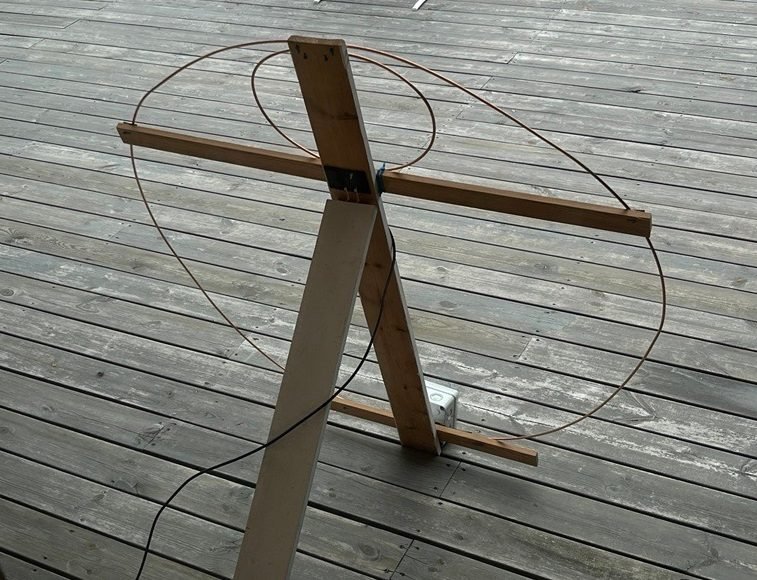
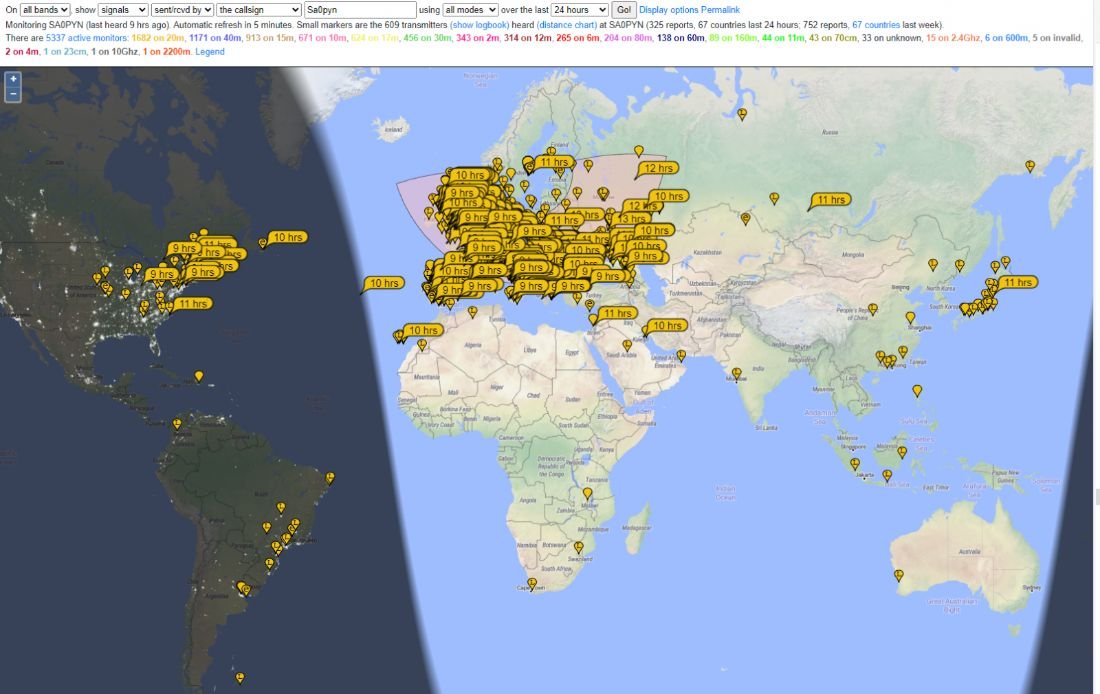
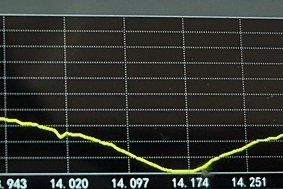
My magnetic loop for 20 m (2024). I don't have a commercial HF antenna, so I build my own. This loop is tuned with two air-gap capacitors of about 80 pF in parallel, which made tuning much easier. With my Xiegu X6100 at just 5–10 W, it works really well on 20 m FT8. Read the full story
- Two countries, two licencesLicensed in India as VU3PYN. After moving to Sweden, Naresh studied for and passed the Swedish amateur radio exam, overseen by SSA, and now operates as SA0PYN. VU3PYN is QRT for now.
- Homebrew antennas, QRP powerRuns a Xiegu X6100 at 10 W maximum with home-built dipole and inverted-V antennas. In summer 2024 he built a magnetic loop, tuned with two ~80 pF air-gap capacitors in parallel, and was really impressed with it on 20 m FT8, with PSKReporter spots from August 2024 at just 5–10 W.
- QRZ.com awardsMaster of Radio Communication – Europe · Grid Squared Award · World Continents Award · World Radio Friendship Award · 30 Years of QRZ
- Hamfest India 2019Joined India's annual national gathering of radio amateurs.
- Maker and builderDesigns lithium battery packs, a DIY spot welder and a 24V mini powerwall, the kind of power that keeps a station running off-grid.
- Sharing the knowledgePublishes build guides on Instructables and videos on YouTube so others can make them too.
Countries are looked up with IP Geolocation by DB-IP.
Projects
- Magnetic Loop Antenna for 20 mHam radio
A home-built loop tuned with two air-gap capacitors. Works great for FT8 at 5–10 W.
- Movable Wooden WorkbenchWoodworking
A sturdy workbench on wheels for the workshop.
- DIY Spot Welder for Lithium Battery Pack BuildingLithium
A homemade spot welder for joining nickel strip to 18650 cells.
- Hamfest India 2019Ham radio
Notes from India's amateur radio gathering.
- Building a 12V Lithium-Ion Pack: 3S10P with 18650 CellsLithium
A 30-cell 12V pack, spot welded.
- 24V Mini Powerwall with 18650 CellsLithium
A small home storage pack built from 18650 cells.
Videos & more builds
Build videos from the workshop and the shack.
About
I'm Naresh, a hobbyist who loves exploring new technology and a proud ham radio operator: VU3PYN in India, and SA0PYN since moving to Sweden. This site collects the things I build at home: lithium battery packs and the tools to make them, solar power setups, Arduino and Raspberry Pi experiments, and the occasional woodworking project.
Privacy
This page uses no cookies, no tracking and no analytics. YouTube videos load only if you click them.
Read more (GDPR)
- Who: Naresh (VU3PYN / SA0PYN) runs this site. You can reach me through QRZ.com or by email: vu3pyn [at] gmail [dot] com
- "Say 73" button: it counts taps and which country they come from. Your IP address is used once to look up the country and is not stored. Country data: DB-IP.
- Hosting: Hostinger logs your IP address to deliver the page and keep it secure (GDPR Art. 6(1)(f)).
- Videos: when you click a video, YouTube (Google) receives your IP address and may set cookies. See Google's privacy policy.
- Video choice on blog posts: you can tick "always show YouTube videos". That choice is saved in a small cookie in your browser, and you can undo it by clearing your cookies.
- Your rights: you can ask to see, correct or delete your data, and complain to IMY, the Swedish data protection authority.